ETFE lining by rotolining

We line the inside of steel parts with ETFE. We have done this since 1989 by rotolining, on machines we built ourselves. Customers mainly use it for tanks, pipe spools, valves and flow tubes that come into contact with aggressive chemicals.
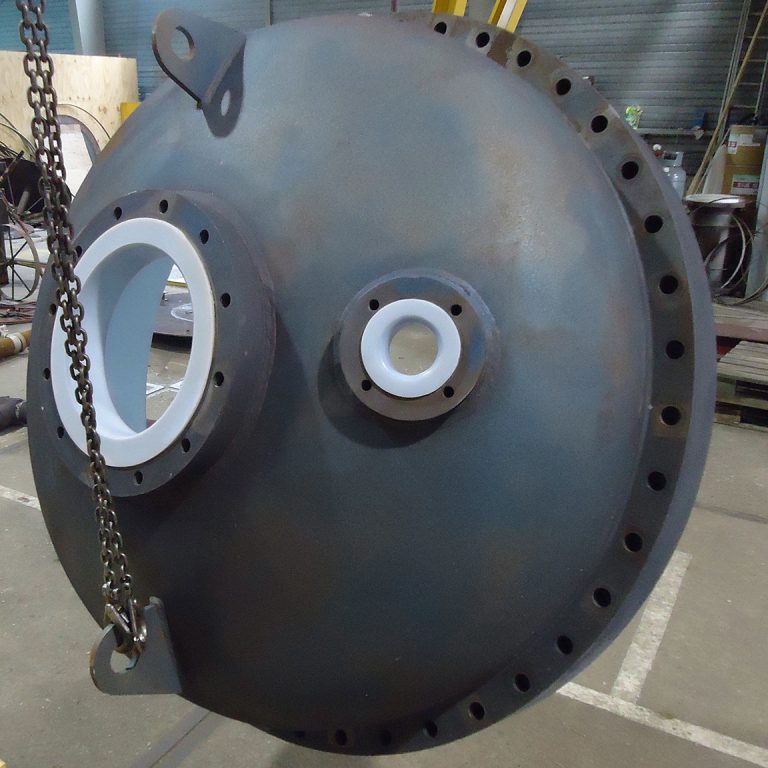
Tank head with ETFE lining, applied by EHRI

ETFE

ETFE is a fluoropolymer, like PTFE and PFA, and resists nearly all acids, alkalis and solvents. The big difference with PTFE: ETFE bonds very well to the steel. A PTFE liner sits loose inside the part, which makes it unsuitable for vacuum. An ETFE lining is bonded, so it can handle vacuum. ETFE is also tough and wear resistant, so it does not damage easily during assembly or cleaning.

Rotolining

First we blast the steel to Sa 2½, deliberately with a very rough profile. Most others do not do this for ETFE; that rough profile is why our lining bonds so well. Then the part is filled with ETFE powder, closed and turned through a full 360 degrees, over and over, in the oven. The powder melts and flows over the whole inner surface. So there are no seams or welds in the lining, not even in bends or tees. We record temperatures and times for every part.

PS 401

We use ETFE PS 401. It handles higher temperatures than ordinary ETFE: up to 180 °C, with good chlorine resistance. Where PFA or PEEK used to be specified, PS 401 now does the job in most cases, at a much lower price. See also Rotomoulding & PS 401.

What we line

  • Storage and process tanks, tank heads and covers
  • Pipe spools, bends, tees and flanges
  • Valves, check valves and pump housings
  • Flow meter tubes
  • Other parts to drawing

Our customers include Shell, BP, ExxonMobil, BASF and Krohne.

ETFE or PFA?

PFA and PTFE can go even hotter, but cost a lot more. If your process stays below 180 °C, ETFE is usually enough. Not sure? Call or e-mail us with the medium and temperature and we will tell you what we would use.

Questions we often get

Up to what temperature can ETFE be used?

Our PS 401 up to 180 °C.

Is ETFE coating the same as ETFE lining?

In practice, yes. Both mean a layer of ETFE on the inside of a part.

Can ETFE replace PFA or PTFE?

Up to 180 °C usually yes, and it costs less.

Is an ETFE lining suitable for vacuum?

Yes. ETFE bonds to the steel, especially because we blast the steel to Sa 2½ with a very rough profile. A PTFE liner sits loose and is therefore not suitable for vacuum.

Does it work on complex shapes?

Yes, the powder flows everywhere while rotating, including bends and tees.

How do I get a price?

Send a drawing through the contact form or to ehri@ehri.nl, or call +31 (0)186 605 901.

Request a price

Send a drawing or a photo with dimensions. We will tell you the price and when it can be ready.